Spiritual Formation · Free guide
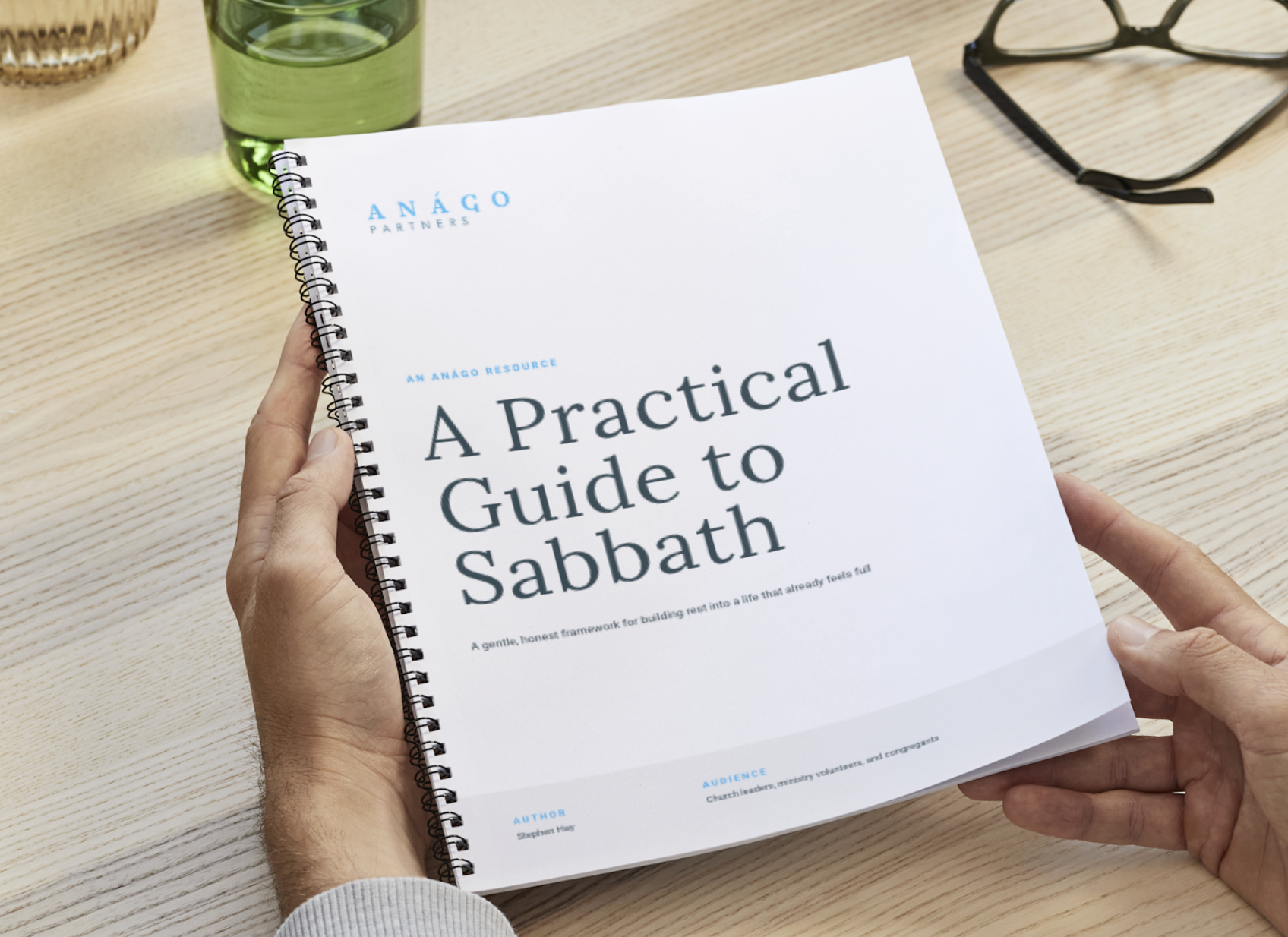
A Practical Guide to Sabbath.
A gentle, honest framework for building rest into a life that already feels full, for leaders and anyone whose calling won't slow down on its own.
A confession, not a command
The people who talk most about Sabbath practice it least.
Not because they're hypocrites. Because they're drowning, and they genuinely believe they cannot stop swimming. Most of the leaders I respect have been that person. I have been that person.
Before we get to the how, it's worth naming the truth: the reasons we don't rest are almost never the ones we think they are.
Why we don't rest
Four forces that quietly keep good people from Sabbath.
Identity fusion
When your work is also your calling, stopping feels like disappearing. Rest doesn't just feel unproductive, it feels unfaithful. A person who knows who they are apart from their role can set the role down for a day. A person who doesn't cannot.
Structural barriers
Sunday is work, emotionally demanding, publicly performed, spiritually high-stakes work. According to the Duke Clergy Health Initiative, 43% of clergy were not keeping a regular Sabbath. The commandment they teach others to keep is the one they most consistently break.
A theology of productive faithfulness
Absorbed often without realizing it, this teaches us that busyness is evidence of commitment and rest is evidence of insufficient zeal. Most of us would say God doesn't need us to hold his church together. But we act as if he does.
Guilt in both directions
There's guilt when we don't rest, and, ironically, guilt when we do rest, about what's undone, whether we're doing it right, the call we didn't return.
A better story
Sabbath isn't what God commanded first. It's what God made.
After the work of creation, God rests, not from exhaustion, but as an expression of satisfaction. The seventh day is sanctified. Set apart. Made holy.
Abraham Joshua Heschel calls this the "holy architecture of time": Sabbath as a palace built not in space, but in time itself. The most sacred thing in creation isn't a temple or a mountain. It's a day. A regularly recurring invitation to enter divine rest.
Walter Brueggemann takes it further: Sabbath is resistance. A refusal of Pharaoh's economy, the relentless production machine that assigns human worth by output. When God commands Sabbath for a newly freed people, it is a declaration: you are not what you produce.
At its deepest level, the inability to rest is a trust problem. We stay busy because we believe, somewhere beneath our theology, that things will fall apart if we stop. Sabbath says: I will let God be God for 24 hours without my supervision.
Inside the guide
Six principles for actually building Sabbath into a full life.
- How to find your day when Sunday is your workday, and how to protect it
- Why defining what rest means for you matters more than any formula
- The practice of ceasing before you can truly rest, and the small, well-timed preparation that makes it possible
- How to guard against Sabbath drift, when the exceptions accumulate until there are no non-exceptions
- How to scale your rest to your season without abandoning the practice entirely
- How Sabbath, practiced consistently, eventually reframes the whole week
The guide also addresses the common objections honestly: my situation is different, I've tried before and couldn't sustain it, it feels selfish when people need me, because those objections are real, and they deserve real answers.
One place to start
Choose one four-hour block this week.
Not a full day. Just four hours. Mark the beginning deliberately. Do nothing productive. Do something that restores you. See what happens. Sabbath doesn't require you to have it figured out. It only requires you to step through the door.
Adapted from Stephen's essay Why the People Who Talk Most About Sabbath Practice It Least, originally published on Anágo Partners.